

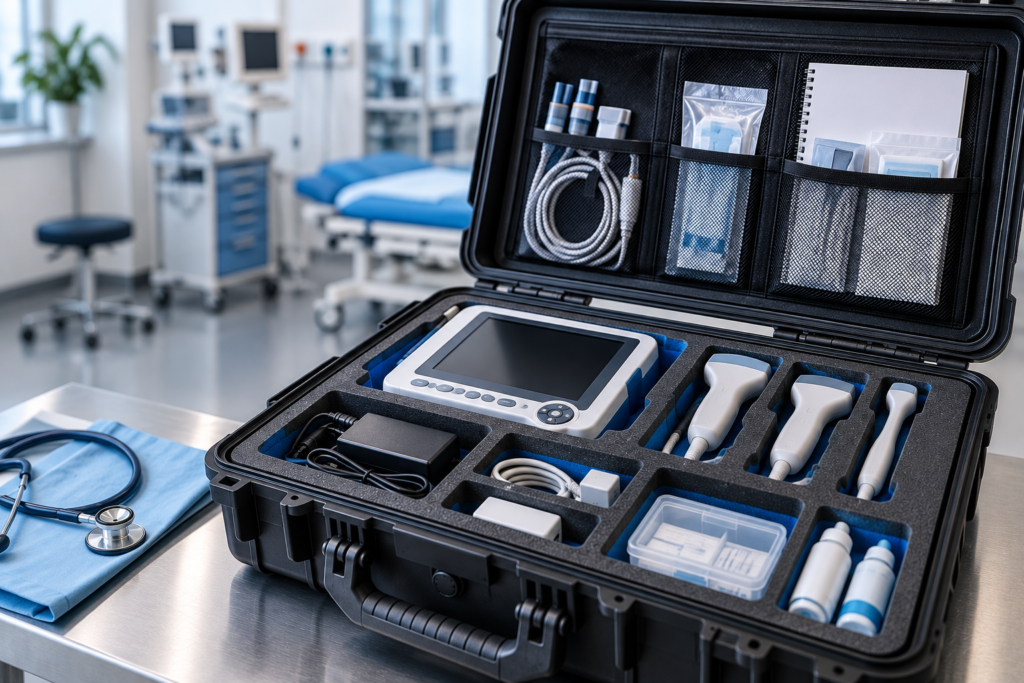
When medical equipment travels, the main device is rarely traveling alone. A diagnostic instrument may need to stay with probes, sensors, cables, adapters, power supplies, documentation, and other supporting components.
That makes the inside of the case just as important as the case itself.
A well planned medical equipment case interior gives each part of the kit a logical place. Some components may need fitted foam. Others may be easier to manage with dividers, compartments, or lid storage. The best layout depends on how the equipment is actually used, transported, opened, and repacked.
Start With the Complete Medical Equipment Kit
It is tempting to begin with the largest device and design everything else around the space that remains. For medical equipment, that can quickly create problems.
A diagnostic unit may fit perfectly while its probes have nowhere to go. A power supply may end up sharing space with cables. Small adapters can become difficult to find if they do not have a defined location.
Planning should begin with the entire kit, including:
- The primary medical device
- Probes and sensors
- Cables and connectors
- Power supplies and adapters
- Handheld components
- Documentation
- Supporting or replacement components
This is especially important when developing medical and pharmaceutical case solutions because the interior may need to accommodate several pieces that work together as one system.
The question is not simply, “Will the device fit?” It is, “Will the complete kit make sense when someone opens the case?”
Use Custom Foam Where Consistent Placement Matters
Some medical components benefit from returning to the same position every time the case is packed.
A fitted foam cavity can create a dedicated location for the main device, while smaller cutouts can be used for probes, adapters, sensors, or handheld instruments that should remain separated.
A custom case interior can combine die cut foam inserts, foam lining, rigid dividers, moveable dividers, compartments, and lid organizers depending on the equipment.
Foam does not need to fill every open area. It is most useful where fitted support and consistent placement are important.
For components that regularly travel as part of the same medical kit, custom foam inserts can create dedicated spaces that make it easier to see where each item belongs.
Give Changing Accessories More Flexibility
Medical equipment kits are not always identical from one use to the next.
The primary device may stay the same while cables, attachments, adapters, or supporting accessories change. In those situations, giving every item its own permanent foam cavity can make the interior too rigid.
Moveable dividers can provide more flexibility for components that change. Rigid dividers can keep groups of accessories separated without fixing every piece into one exact position.
A hybrid layout can often make more sense.
For example, the main diagnostic instrument may sit in fitted foam while cables and power components are kept in divided compartments. Smaller accessories may have their own sections, while paperwork or lightweight components can be stored in the lid.
The goal is to create structure without making the case difficult to adapt.
Think About the Moment Someone Opens the Case
A medical equipment case should feel intuitive when it is opened.
Frequently used components should be easy to identify and reach. A user should not need to remove unrelated items just to find one cable or probe. Smaller components should have recognizable locations so it is easier to see whether the complete kit has been returned before the case is closed.
Imagine a portable diagnostic system.
The main unit sits in a fitted section. Probes have their own positions beside it. The power supply is kept in a separate compartment. Documentation is stored in the lid.
That type of layout turns the interior into an organized working system rather than simply unused space around the equipment.
Similar thinking applies to custom cases for medical samples and equipment, where the contents and the way they travel influence how the interior should be organized.
Consider How the Medical Equipment Will Travel
The same device may need a different interior depending on how often and how far it moves.
A case that is carried between departments is handled differently from one that is regularly shipped between facilities, service locations, or customers.
The International Safe Transit Association emphasizes the importance of understanding how packaged products are shipped, handled, and stored when evaluating their distribution environment.
For medical equipment, that means transportation should be considered alongside the device dimensions and accessory layout.
A frequently shipped diagnostic system may benefit from a more structured interior, while equipment that is mainly hand carried may place more emphasis on quick access and repacking.
Prepare the Full Equipment List Before Design Begins
A better interior starts with better information.
Before the layout is finalized, gather the dimensions and weight of the primary device along with photos or drawings and a complete list of everything that travels with it.
Also identify:
- Which components need fixed positions
- Which accessories may change
- Which items need to stay separated
- What needs to be accessed first
- How the case will be transported
- How often the equipment will be removed and repacked
If the complete medical kit cannot be accommodated effectively by a standard configuration, a custom case can be planned around the equipment dimensions, accessories, and interior layout instead.
Build the Interior Around How the Medical Equipment Is Really Used
There is no single layout that works for every medical device.
One system may need several fitted foam cavities. Another may need one protected area for the main device with flexible storage around it. A third may depend heavily on dividers because its accessories change frequently.
The strongest medical equipment case interiors are built around the complete kit and the people who need to use it.
Foam, dividers, compartments, and organizers should each have a clear purpose. When every component has a place that makes sense, the case becomes easier to open, use, repack, and prepare for its next trip.
Companies planning a new medical equipment case can contact Case Design Corporation to discuss the device, accessories, transportation requirements, and interior configuration.